Three Subtitle Formats Look Alike, but One Conversion Reveals What Each Can Hold
When you download videos and subtitles with a desktop video browser like VidBrowser, the format is largely decided by the source: subtitle tracks from video platforms mostly come as SRT or VTT, while polished effects subtitles from fansub groups are usually ASS. Three files with different extensions carry different things; turning one into another comes down to subtitle format conversion — and the first thing to get clear is not which tool to use, but the direction: some directions are nearly lossless, and in others the styling stays behind entirely.
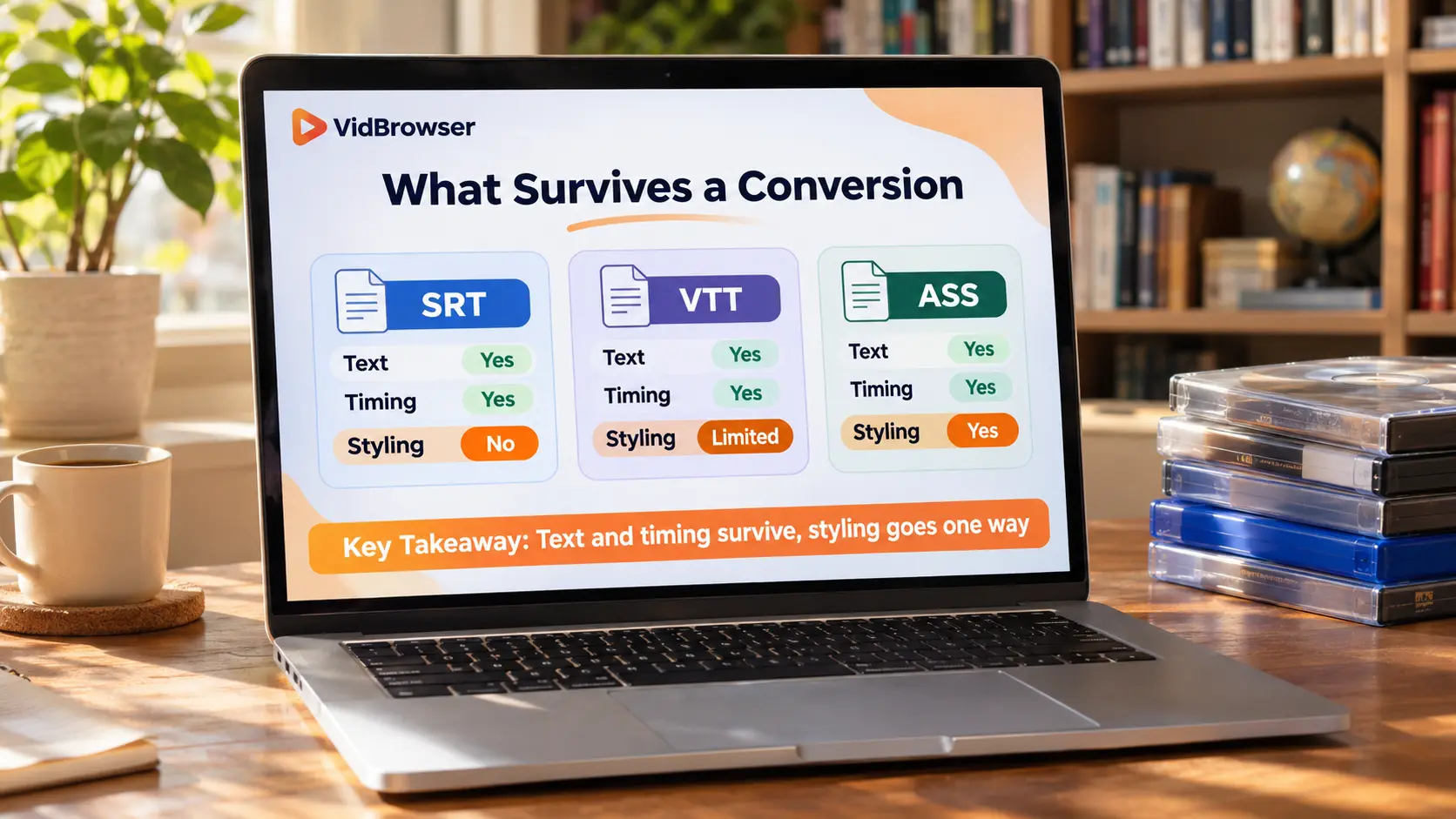
Subtitle conversion starts with direction: text and timing survive, styling does not
What one conversion preserves depends on whether the target format can hold it, not on how strong the tool is.The three formats differ widely in capability: SRT is plain text plus timing, and its grammar has no room for fonts or colors; VTT adds lightweight styling and positioning under the web standard; ASS is outright a layout script. Converting from a richer format to a poorer one leaves the styling with nowhere to go — it gets dropped at the boundary of what the format can express, whichever tool you pick. Text and timing are the shared foundation of all three and travel in any direction. Decide where you are going and what it accepts, then decide whether to convert.
ASS is the most capable subtitle format, supported by the fewest players
ASS stands for Advanced SubStation Alpha, upgraded from the 1990s-era SSA, and has been the de facto standard in the effects-subtitle world for years.Aegisub, the open-source editor built around it, handles line-by-line timing, live preview, per-line font, color and on-screen position, and even karaoke word-by-word color effects. Anime timing and effects, on-screen letters and sign translations, lyric and annotation subtitles mostly come from its hand. The cost is just as clear: among desktop players, only those with the built-in libass engine such as VLC and mpv render it fully; web players do not accept it, and mainstream video platforms refuse it on upload. SSA is its predecessor and a capability subset — old files are nothing to be surprised by; for new styled subtitles, go straight to ASS.
SRT to VTT is an upgrade, ASS to SRT is a teardown
Converting the same file in two directions does not give symmetric results.SRT and VTT share one timing model, so converting between them is close to mechanical rewriting: VTT adds a WEBVTT header line and uses dots instead of commas for milliseconds — where the two differ and what each is for is covered in the SRT subtitle usage article. ASS to SRT is a teardown: dialogue text and start/end times are kept as-is, the style block is dropped whole, and positioning and karaoke coloring are stripped along with everything else SRT cannot hold; ASS to VTT carries over part of the positioning, but the mapping is not one-to-one either — details are in the MDN WebVTT documentation. Upload-side limits deserve an early look too: mainstream platforms accept SRT and VTT for subtitle uploads, and ASS usually has to be downgraded first.
Acceptance checks also follow the direction: play the output file from the beginning in the target playback environment instead of trusting how it looked in the original one. Everything above covers subtitle text tracks; container conversion for the video itself follows a different set of rules, covered in the video format conversion article.
How a clean conversion goes: keep the master in the most capable format
Convert once and stop, and keep the master in the most expressive file.Back-and-forth conversions accumulate drift: ASS to SRT and back to ASS, the styling never returns and the timing may pick up small offsets. The open-source Subtitle Edit supports mutual conversion of some thirty subtitle formats with a visual preview; one clean conversion takes four steps:
Step 1: Confirm before converting.Open the original subtitle, check that content and timing are complete, and save a copy as the master — then leave it untouched.
Step 2: Save as the target format.Let the tool handle timecode and structural differences; do not hand-edit.
Step 3: Spot-check the structure.Check that the output keeps its sequence lines, timecode lines and text lines complete; how to fix broken timecode lines is covered in the SRT garbled text and timing fix article.
Step 4: Accept in the target environment.Play it from the start in the player or platform you will actually use, checking timing, line breaks and special characters.
To keep styling intact: soft subtitles and hardcoding, two roads
When the format cannot hold styling, there are two roads that skip conversion.Soft subtitles keep the subtitle file separate, traveling with the video and rendered by the player: ASS styling displays in full, can be toggled at any time and swapped between language versions; the cost is that the files must stay paired and platform uploads mostly reject them. Hardcoding — burning subtitles into the picture — freezes the styling into the frame: it survives even on social platforms that ignore subtitle files, and viewers see it without loading anything; the cost is that once baked in it can be neither turned off nor changed, and deleting the source leaves no way back. The dividing line is whether the styling should travel with the file: for your own collection, pair soft subtitles with ASS; to send to others, consider hardcoding.
Summary
One sentence sums up subtitle conversion: text and timing travel with the file, and styling survives only on the outbound side. Pick the right direction — SRT to VTT is an upgrade, ASS to SRT is a teardown; keep the master in ASS and convert once; accept the result in the target playback environment. To present styling as-is, use soft subtitles or hardcoding, and do not expect a converter to save what the target format cannot hold.
FAQ
After ASS to SRT the font colors are all gone — is the converter broken?
No. SRT grammar has no room for fonts, colors or positions; the converter kept the text and timing, and stripping the styling is the boundary of the format. Keep the ASS original if you need styling, or burn the subtitles into the picture.
Does converting back and forth make subtitles worse and worse?
Yes. Every conversion rewrites the file under the expressiveness of the target format; after a few round trips small timing offsets accumulate, and the styling is gone the moment you first convert to a simpler format. Fixed practice: keep the master in ASS, stop at the SRT or VTT version you exported, and if styles need changes, go back to the master, edit and export once more.
Are ASS and SSA the same format?
Related but not the same. SSA is the older 1990s version with basic styling only; ASS is its upgrade, adding layers, fade in and out, motion and rotation, and karaoke effects — fansub groups and toolchains now write ASS. Most players that read ASS also handle SSA files.